Why swing speed matters in badminton
Ask any coach what separates a threatening smash from a harmless one and the answer comes back to speed. A fast badminton swing is the visible result of an efficient kinetic chain: power generated in your legs and hips travels through the trunk, shoulder and forearm, and is finally released through the racket head in a fraction of a second. When one link leaks energy, your smash speed drops — and your opponent gains time.
Swing speed is also one of the most honest progress indicators in the sport. Footwork and tactics are hard to quantify, but a swing speed tracker gives you a number you can compare week after week. If your technical work is paying off, your smash speed climbs. If it plateaus, you know exactly where to focus next.
Until recently, measuring badminton smash speed meant booking a radar gun session or a sports lab. Today the sensor you need is already on your wrist.
How GoodShot measures your swing speed
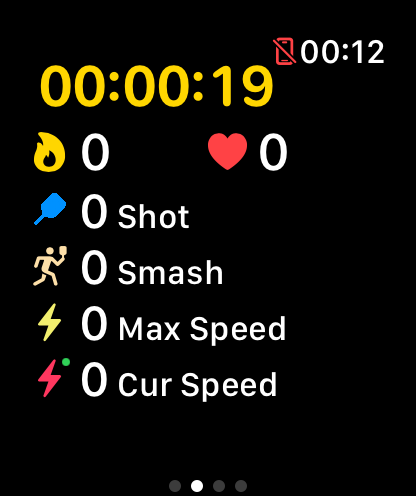
Your Apple Watch already contains a high-frequency accelerometer and gyroscope — the same class of sensors used in professional motion-capture systems. GoodShot puts them to work on court:
- Wear it on your racket hand. Start a session on the watch before you play. Your iPhone can stay in your bag.
- AI shot recognition. GoodShot's motion model reads each swing's signature and classifies it as a smash, clear, drop, lift or drive — and tells forehand from backhand.
- Speed per swing. Every recognized swing gets a speed reading in km/h, so you can compare your fastest smash of the day against your session average.
- Full review on iPhone. After the game, open the app for shot-by-shot speed charts, trends over weeks and heart-rate data synced to Apple Health.
Because the AI distinguishes shot types, GoodShot reports speed per category — your smash swing speed is never averaged away by slow defensive lifts. That makes it a genuinely useful badminton swing speed tracker rather than a generic motion counter.
How fast is a badminton smash? Reference data
Curious how your numbers stack up? Here is a rough comparison of smash speeds across player levels, based on publicly reported measurements from tournaments and training broadcasts:
| Player level |
Typical smash speed |
| Recreational / beginner |
150–200 km/h |
| Intermediate club player |
200–250 km/h |
| Advanced / competitive amateur |
250–350 km/h |
| Professional (men's singles) |
400+ km/h |
These figures are approximate ball-flight speeds measured by broadcast radar systems, shared for general reference only. GoodShot measures the speed of your racket-hand swing from the wrist — a different but closely correlated metric. Don't chase an absolute number; use your own readings to track progress over time.
5 ways to increase your badminton swing speed
- Power from the ground up. A smash starts with your legs. Push off, rotate your hips and let that momentum travel up the trunk before your arm even accelerates. Arm-only smashes cap out early.
- Relax your grip until contact. A death-grip locks your wrist and kills racket-head speed. Hold the handle loosely through the swing and squeeze only at the moment of impact — the classic "finger power" snap.
- Pronate the forearm. Forearm rotation is the biggest single contributor to overhead shot speed. Practice the whipping motion of internal rotation through contact, not a stiff straight-arm hit.
- Contact in front and high. Meet the shuttle at the highest point, slightly in front of your body. Contacting late or behind your head forces a weak, cramped swing.
- Measure every session. What gets measured gets improved. Track your smash speed with GoodShot after each change in technique or training, and keep what actually moves the number.
Swing speed tracking FAQ
Can a smartwatch really measure badminton smash speed?
Yes. The accelerometer and gyroscope in Apple Watch sample your wrist motion at high frequency during a swing. GoodShot's AI model reads that motion signature, classifies the shot and estimates the swing speed in km/h — no radar gun or extra hardware needed.
What is a good badminton smash speed for an amateur?
As a rough reference, most recreational players smash in the 150–250 km/h range, trained club players can reach 250–350 km/h, and top professionals exceed 400 km/h in competition. These are ball-flight figures from broadcast measurements — wrist-measured swing speed is a different but closely correlated metric, best used to track your own progress.
Does GoodShot measure smash speed or swing speed?
GoodShot measures the speed of your racket-hand swing from the watch on your wrist, and uses the recognized shot type to report it per category — so you can compare your smash, clear and drop swing speeds separately. It is a practical proxy for smash power that lets you track improvement session by session.
Which Apple Watch do I need to track swing speed?
Any mainstream Apple Watch running a recent watchOS works, including the Apple Watch Series lineup, SE and Ultra. Wear the watch on your racket hand and start a GoodShot session before you play — newer models sample motion more smoothly.
How can I increase my badminton swing speed?
Focus on the kinetic chain: generate power from your legs and hips, accelerate through forearm rotation and a relaxed finger-snap grip, and time the contact point in front of your body. Then measure every session with a swing speed tracker like GoodShot so you can see what actually works.
Find out how fast you really smash
Download GoodShot free, wear your Apple Watch on court, and get the speed of every smash, clear and drop — session after session.
Download on the
App Store